Some companies have a workhorse. We're building you a War Horse.

Built from the field

Field operations break when your systems don't talk to each other.

Destrier connects dispatch, CRM, fleet tracking, compliance, time clocks, forms, work orders, and reporting into one operational system built from the field.

Find the closest operator during an emergency.

Keep crews working when cell service drops.

Stop losing paperwork between the field and office.

Track work, time, vehicles, forms, and evidence in one place.

Give mobile users the same workflows desktop users have as the parity target.

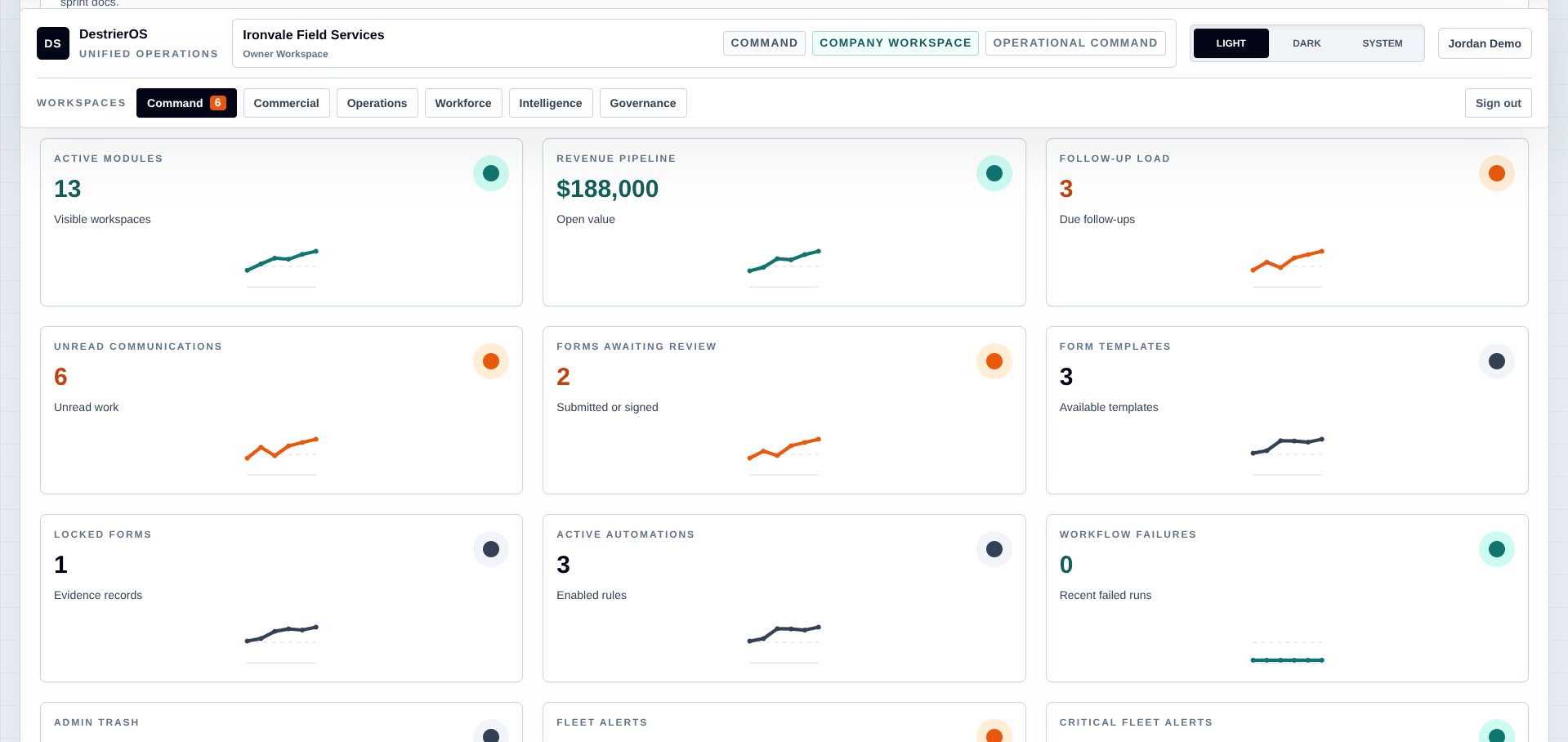
DestrierOS dashboard showing connected operational widgets, active modules, follow-up load, approvals, training, and readiness signals.
Product proof: connected operating modules, readiness signals, follow-up load, approvals, and field-work context in one workspace.

Built from the field

Designed by an operator who got tired of forcing broken systems to cooperate.

Destrier was built by someone who spent years dealing with disconnected field systems, not by a software team guessing what operations needs.

DestrierOS started in oil field operations after nine years of operational frustration, where critical work was scattered across Power Apps, telematics portals, Excel sheets, inboxes, phone reminders, and tribal knowledge. After years of looking for one unified operating system and being told it did not exist, the founder went to Carnegie Mellon University to acquire the technical skills to build it himself. The first lines of DestrierOS were written on an oil rig, on a laptop that still has frac mud clogging the keyboard. He still works the rigs, and DestrierOS funds itself.

The operating problem

Nine years of field frustration became the product requirements.

The early version of Destrier was not imagined from a conference room. It came from oil field work where critical handoffs lived in Power Apps, telematics portals, Excel sheets, inboxes, phone reminders, and tribal knowledge.

The technical turn

When the system did not exist, the founder learned to build it.

After years of looking for one unified operating system and being told it was not available, the founder went to Carnegie Mellon University to acquire the technical skills to build the system himself.

The first code

The first lines were written on an oil rig.

DestrierOS started on a field laptop that still has frac mud clogging the keyboard. That detail matters because the product is judged against real field conditions, not a perfect software demo.

The trust hook

Still working the rigs, still funding the product.

The work is self-funded while the founder keeps operating in the field, which keeps the product close to the daily friction it is supposed to remove.

Operator and trades perspective before software-founder perspective
Nine years of operational frustration turned into product requirements
Self-funded while the founder keeps working in the field
Built around the real friction of field-to-office handoffs
Shaped by the systems teams already use when nothing talks cleanly

Current product status

DestrierOS is led by the current web command center, with native desktop, mobile, and kiosk workflows expanding around field operations.

For commercial and industrial teams, the current web version is the primary working surface for customer work, field execution, fleet visibility, workforce controls, billing, compliance evidence, and reporting. A Linux native desktop version is running as the local-workstation path for offline compatibility and field-office resilience. The mobile app is in early-alpha field-work validation and is being rebuilt screen by screen for field-ready web parity; the mobile app is in early-alpha validation until real-device pilots prove the workflow. Kiosk hardware case design and packaging are complete, and the kiosk appliance is ship-ready for customer field use with NFC, pairing, sync, Wi-Fi, update paths, offline replay, and device governance.

Run the work

Follow a customer from lead to job, field execution, kiosk punch, documents, invoice handoff, and reporting without rebuilding context in every department.

Surface the next action

Queues, approvals, missing evidence, stale work, inventory pressure, support issues, GPS exceptions, and kiosk/device health are meant to be visible before they become surprises.

Keep evidence

Sensitive actions leave an audit trail: approvals, role changes, exports, billing adjustments, field closeout, kiosk events, support assist, compliance reviews, and release operations.

Decide faster

Leadership gets a cross-surface picture of operating health, workload, adoption, risk, margin, field movement, and follow-up without waiting on another spreadsheet cleanup.

Not just a browser tab

DestrierOS is built to reach the places where the work actually happens.

Current web version

Web command center

The browser product is the current primary system of record for customer work, dispatch, workforce, fleet, finance evidence, compliance, reporting, administration, and support.

Early alpha app

Mobile field app

The mobile app is in early-alpha field-work validation while it is being rebuilt for field capture, offline work, evidence, scheduling, customer context, GPS-assisted workflows, and approvals.

Linux version running

Native desktop app

The native desktop app gives Destrier a local workstation surface for offline compatibility, field-office resilience, and long-running operator workflows beyond a browser session.

Ship-ready appliance

Kiosk terminals

The kiosk appliance is ship-ready for time-clock and location registry terminals with RFID/NFC credential flows, offline event replay, org governance, completed case design, packaging, Wi-Fi setup, pairing, sync, and update paths.

Fleet signal live

GPS and device signal

Dedicated hardware and mobile GPS signals feed locations, assets, drivers, geofences, maintenance, trip evidence, and exception review into the same operating record.

What the demo proves

A real operating chain, not another dashboard island.

Replace scattered spreadsheets, inboxes, point tools, and hardware portals with one operating record
Give sales, dispatch, field, finance, HR, compliance, and leadership the same source of truth across web, mobile, kiosk, and device signal
Make blockers, missing evidence, stale work, GPS exceptions, kiosk events, and risk visible while there is still time to act
Keep audit history attached to the work, people, places, and devices instead of chasing it later

Walkthrough path

The product is easiest to understand by following the work.

Step 1

Start with a customer

Create or open the account, review history, capture the next conversation, and see open revenue, service, documents, and finance context.

Step 2

Turn work into execution

Move from request to service queue, schedule or assign work, attach required evidence, and keep field closeout from skipping required steps.

Step 3

Connect fleet and inventory

Bring assets, GPS devices, mobile location, shared terminals, parts, purchasing, shortages, and vendor context into the same operational picture.

Step 4

Close with proof

Review approvals, invoices, kiosk events, mobile evidence, compliance records, reporting, and support history so the buyer sees how the platform protects the operation.

Operational systems unified in one platform

The roadmap is organized around operating surfaces and software categories, not generic feature buckets.

Most operations teams are still managing critical workflows across disconnected systems, spreadsheets, emails, and paper processes.

DestrierOS is built around the operational systems companies already rely on every day: CRM, field operations, mobile work, GPS and telematics, kiosk time and site access, training, fleet visibility, compliance, finance, analytics, documents, inventory, communications, automation, and platform administration unified into a single operational platform.

Fewer disconnected systems. Less duplicate data. Faster coordination between office teams, field crews, shared terminals, and physical devices.

CRM

Salesforce

Revenue operations, customer overview, quotes, forecasting, and sales activity.

SVC

ServiceNow

Service intake, work queues, SLAs, approvals, escalations, and knowledge.

HR

Workday

Employee lifecycle, time, leave, payroll closeout, and workforce reporting.

LMS

Cornerstone

Learning authoring, assignments, certifications, assessments, and core compliance loops; SCORM/xAPI, proctored exam, and content marketplace parity are not claimed.

FLT

Samsara

Fleet visibility, Teltonika-backed devices, telematics, geofences, maintenance, coaching, and rollout support for industrial operations.

GRC

Vanta

Controls, evidence, access reviews, risk, corrective actions, and audit exports.

FIN

QuickBooks

Invoicing, customer-owned provider-dependent payments, receivables, payables, bank import/reconciliation, tax evidence for professional review, and accountant-reviewed closeout.

BI

Power BI

Curated operational dashboards, governed saved reports, scheduled analytics packages, executive KPI governance, source lineage, and scoped exports; arbitrary semantic modeling, unrestricted data lake, and full BI platform parity are not claimed.

DOC

Documents

Governed templates, approval and signature evidence, controlled external sharing, renewal tracking, contract visibility, and repository migration support.

DOS

DestrierOS

Operational coordination across field, office, compliance, finance, and leadership workflows.

Company and product names referenced on this page are trademarks of their respective owners and are used solely to describe common software categories and operational workflows. Category references describe DestrierOS coverage boundaries, not claims of full vendor parity unless the named replacement sprint and final gap audit have accepted that claim.

Document and contract workflows

Keep templates, approvals, signatures, renewals, and contract evidence tied to the operating record.

DestrierOS connects document work to the same customers, jobs, approvals, evidence, and closeout history teams already use to run the business.

Governed document flow

template ownership, version history, required fields, approval routing, and retirement evidence

approval and signature evidence reviewers can inspect and export

controlled external sharing with recipient, expiry, revocation, delivery, signature, download, and event history

Contract operating visibility

contract lifecycle, renewal, obligation, risk, amendment, and archive visibility

repository migration support for metadata confidence, duplicates, permissions, rollback, and promotion

contract evidence linked back to customer, work, billing, compliance, and service records

Demo surfaces

Start with the workflows buyers already know are broken.

The walkthrough can focus on the parts of the operation causing the most drag: revenue handoff, service intake, fleet context, field evidence, communication history, or reporting.

Revenue core

Live

Customer records, pipeline governance, activity history, quotes, handoffs, and revenue reporting in one workflow.

Communications

Built

Business inboxes, chat, notifications, drafts, scheduled send, sync, and suppression evidence.

Fleet and GPS signal

Live

GPS, devices, drivers, assets, geofences, maintenance, live tracker data, trip/event evidence, investigations, driver identity, and fleet product boundaries.

Mobile field work

Field app

Field workflows, offline evidence, work detail, CRM context, scheduling, approvals, and GPS-assisted operating context are being rebuilt for phone-first parity.

Kiosk terminals

Ship ready

Custom time clock and location registry kiosk appliance is ship-ready with completed case design, NFC, pairing, sync, Wi-Fi, update paths, offline replay, and device governance.

Service operations

Live

Intake, queues, SLAs, approvals, knowledge, field evidence, customer visibility, and operational analytics.

Web command centerMobile field appNative desktop appKiosk terminalsGPS device signal

Book a Demo

See whether DestrierOS fits your operating mess.

Tell us where the friction is: CRM handoff, service dispatch, fleet visibility, inventory, compliance, billing, reporting, or support. The demo will follow that workflow instead of forcing you through a generic product tour.

Buyer questions

Why mention familiar software categories?

They frame the operational software categories the roadmap addresses. The product is long-term and phased around one operating record: web command center readiness, buyer-ready launch, mobile field work, kiosk terminals, GPS devices, and hardware-backed operating evidence.

What is usable today?

The current web version has working surfaces across CRM, communications, fleet/GPS, employees, HR, forms, learning, reports, compliance, accounting, work orders, inventory, documents, contracts, and admin controls. Live fleet hardware data is flowing through the dedicated ingestion edge, the mobile app is being rebuilt for phone-first web parity, and the kiosk appliance is ship-ready with completed case design, NFC, pairing, sync, Wi-Fi, update paths, offline replay, and device governance.

Is this only software on a computer?

No. The web app is the command center, but the product strategy includes mobile field workflows, shared time-clock/site-access kiosks, and GPS or telematics devices feeding real operating signal back into the same company record.

What makes the roadmap different from ordinary SaaS module creep?

The roadmap is organized around complete operating workflows: who owns the work, what evidence is required, what can be reported, and what happens when something is blocked.